
Guide · · 3 min read
Plain automation or AI automation? A decision guide for your business
Not every repetitive process needs AI. Here is how to tell whether a rule-based workflow is enough or your process needs an AI agent — with the guardrail design that makes an AI agent safe to run unattended.

Muhammad Syaiful Anwar
Founder & Lead Engineer, ASIIFDEV
"AI automation" gets used for two very different things: a plain rule-based workflow (form fills a spreadsheet, spreadsheet triggers a notification) and an AI agent that reads unstructured input and decides what to do. Selling the second when the first would do is how automation projects end up overpriced and overcomplicated. Here is how to tell which one you actually need.
Start with the input, not the ambition
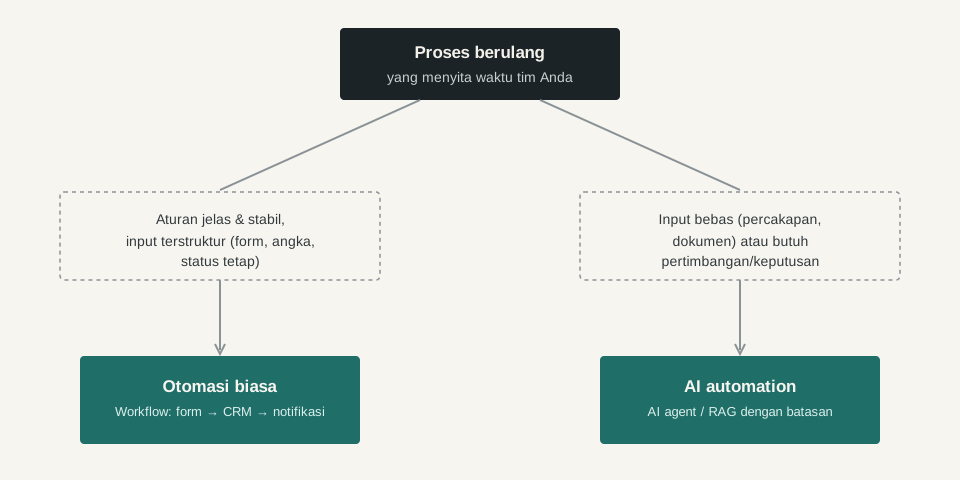
The question that actually decides this is not "how advanced do we want to look" — it is what the process receives as input, and whether the rule for handling it ever changes.
When plain automation is genuinely enough
- The input is structured. A form submission, a fixed status, a number — the rule for what happens next does not require interpreting free text or a conversation.
- The rule rarely changes. "When X happens, do Y" has held true for months, not something renegotiated every week.
- Getting it wrong is cheap to notice and fix. A missed notification is annoying, not a lost customer or a wrong quote.
This is most of what people mean by "workflow automation": syncing a form to a CRM, sending a reminder, generating a routine report. It is faster to build, cheaper to run, and there is nothing to "train" — get it right once and it stays right.
When you actually need an AI agent
- The input is unstructured. A customer message, a document, a phone call — anything where meaning has to be extracted before a decision can be made.
- The response requires judgment inside limits, not a fixed script. Negotiating a price within a floor, drafting a proposal from a brief, answering from a knowledge base with citations.
- Volume makes a human bottleneck. One person can answer 30 conversations a day carefully; an agent bounded by the same rules can answer many more without the ceiling.
We have built both kinds of thing. ReachAI is an AI agent reading WhatsApp conversations and deciding how to reply, draft a proposal, or issue an invoice. business-leads-ai-automation, open source on GitHub, is closer to the plain-automation end: it scrapes leads and generates outreach templates on a fixed pipeline, no negotiation involved.
The part that makes an AI agent safe to run unattended: guardrails
An agent that can negotiate or take action needs a hard boundary it cannot cross — not just good intentions in a prompt. In KiosPro, the agent negotiates a trade-in price with a customer, but only inside a price floor the store owner sets; it cannot give away margin nobody approved. Design the limit before you design the conversation.
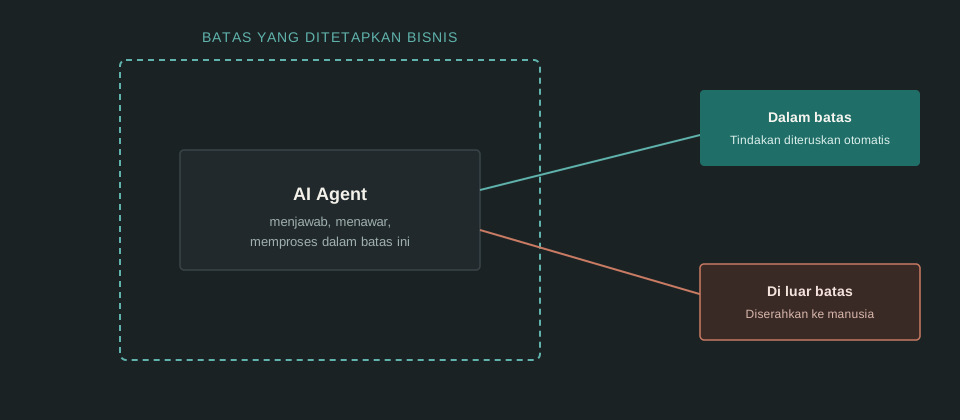
The same principle applies wherever an AI system decides rather than just retrieves: a RAG assistant should decline instead of guessing when its sources do not cover a question. "I cannot do that" or "I could not find that" is a designed outcome, not a bug to apologize for.
What it costs (context, not a quote)
A plain workflow automation is usually the cheaper, faster build — often days, not weeks — because there is no model behavior to test. An AI agent needs the same rigor as any AI system: a prototype with real data, testing against an agreed set of cases, and defined limits before it touches production. We give a real range after a short discovery conversation — see our engagement models — because scope, not ambition, is what drives the number.
How to start
Describe the process, not the tool you think you need: what comes in, what decision has to be made, and what happens today when a human makes that decision. We will tell you honestly whether that is a workflow automation or an AI agent — and if it is the latter, what boundary it needs before it goes live. Start the conversation.